I’ve sat across the table from a lot of MedTech founders. Brilliant engineers. Accomplished clinicians. Deeply technical teams.
And almost every one of them, when I ask “what are you selling?”, answers with a description of their device.
“It’s a wearable continuous glucose sensor with sub-3% MARD accuracy.”
“It’s an AI-powered diagnostic platform for retinal disease.”
“It’s a robotic catheter navigation system.”
Those are products. They’re not businesses.
And the gap between the two is where most MedTech startups quietly bleed out — not because the technology failed, but because they never decided who they are in the eyes of the person writing the check.
This is the Fundamental Entity problem. And it’s the single most important strategic question you can answer before you spend another dollar on commercialisation.
The gap between a product and a business is where most MedTech startups quietly bleed out.
What is a Fundamental Entity?
The Fundamental Entity (FE) is the brand level from which you run your strategy. It’s the answer to “Who are we?” — but answered from the customer’s perspective, not your org chart, not your cap table, not your regulatory filings.
The FE might be your corporate brand. It might be a product line. It might be a single device. The right choice depends entirely on how your customer thinks about you when they’re making a purchase decision.
And in MedTech, “the customer” is already a hairball. You have at least three: the clinician who uses the device, the hospital procurement committee that buys it, the payer who reimburses it. Often a fourth: the patient.
Get the FE wrong, and every downstream decision — positioning, segmentation, pricing, sales channel, even your regulatory strategy — gets built on a faulty foundation.
Why MedTech founders get this wrong more than most
Three reasons.
1. You’re trained to think in product specs.
Your FDA submission is for a specific device with a specific indication. Your CE mark, your 510(k) predicate, your clinical evidence package — all of it is product-level. So it’s natural to define yourself as that product. But your customer doesn’t buy a 510(k). They buy an outcome. A workflow. A reduction in length-of-stay. A way to bill a new CPT code.
2. You forget the “what business are we in?” lesson.
The classic example: railroads went bankrupt because they thought they were in the railroad business. They were in the transportation business. Newspapers thought they were in the newspaper business. They were in the information business.
In MedTech, this plays out constantly. Are you in the stent business or the restenosis prevention business? The insulin pump business or the glycaemic management business? The surgical robot business or the reproducible surgical outcomes business? The frame you choose determines who your competitors are, what your roadmap looks like, and whether you have a moat in five years.
3. You confuse the Fundamental Entity with the company name on your pitch deck.
They are not the same thing. Your company can have multiple FEs. Singapore Airlines, SilkAir, and Scoot are all owned by the same parent — but they’re three distinct FEs because they serve three different segments with three different benefits.
If your MedTech startup sells the same platform into hospital cardiology, ambulatory surgery centres, and a direct-to-consumer wellness channel, you may have three FEs hiding inside one company. Trying to market them as one is why your messaging feels muddled.
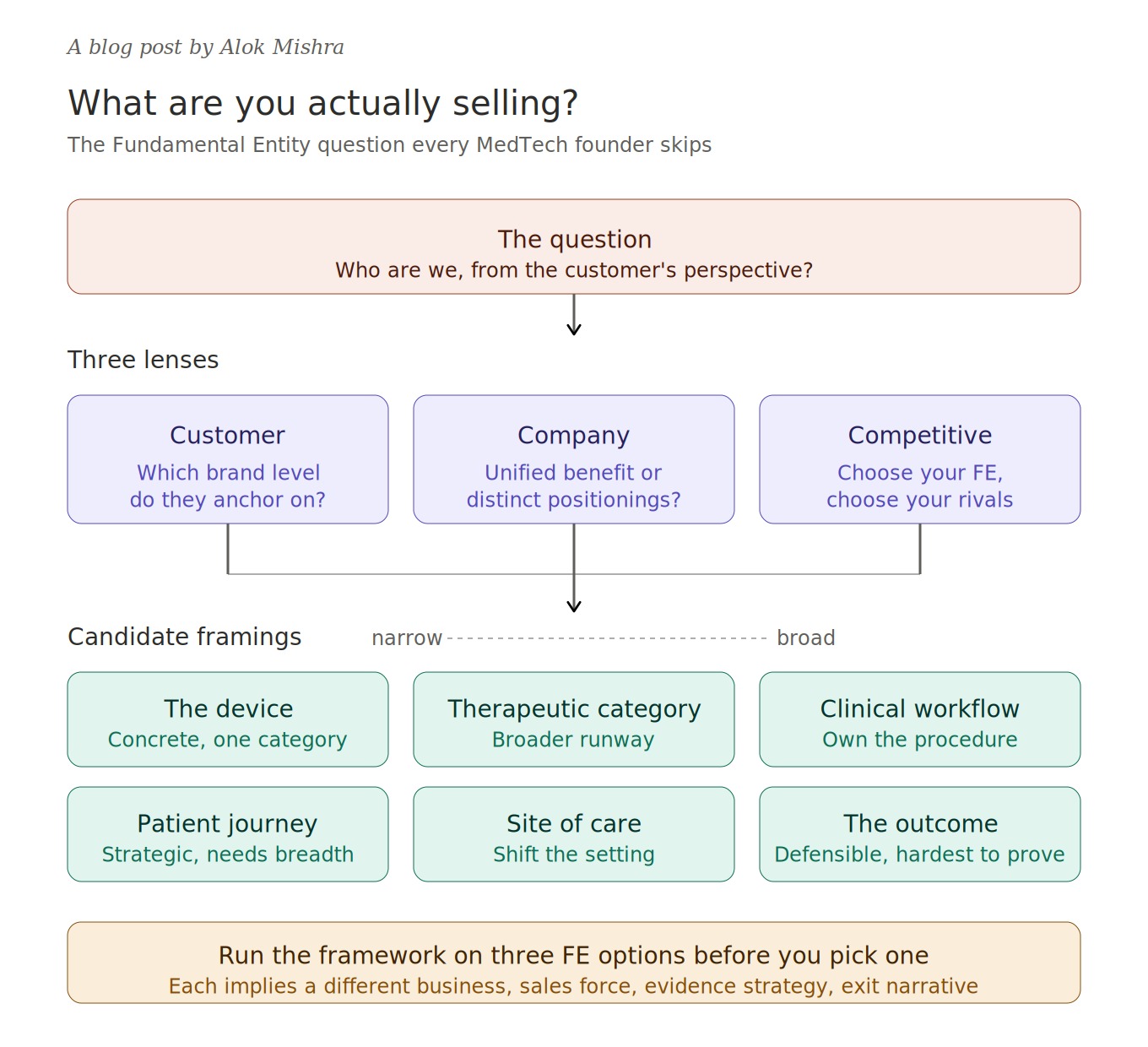
How to define your FE: three lenses
The framework gives you three perspectives to triangulate from.
The customer perspective.
What comes to mind first when your customer thinks of you — the product or the company? When a cardiologist refers to “the MitraClip” instead of “the Abbott valve,” that’s a signal. When a hospital says “we use da Vinci” instead of “we use Intuitive,” that’s a signal. The FE is whichever level the customer actually anchors on. Don’t fight the customer’s mental model — inherit it.
The company perspective.
How are you organised internally? Do new products launch under a unified benefit promise, or does each product start from scratch with its own positioning? In MedTech this often maps to whether you have a platform technology with one core benefit across applications, or a portfolio of independent solutions that happen to share R&D.
The competitive perspective.
This is the lens MedTech founders most often miss. The FE you choose defines your competitive set. If your FE is “AI-powered diagnostic,” you compete with every other AI diagnostic. If your FE is “primary care decision support for diabetic retinopathy screening,” you compete with the status quo of referring patients to an ophthalmologist — a very different battle, with very different evidence requirements, sales motion, and pricing power. Choose your FE, choose your competitors.
Choose your Fundamental Entity, choose your competitors. The FE you pick determines the battle you fight.
FE mapping: the exercise to actually do this
Don’t do this on a slide. Do it on a wall. Sticky notes. Founding team in the room.
Step 1: List everything. Every product, every indication, every channel, every customer segment you serve or plan to serve. Don’t filter.
Step 2: Map it the way your company sees it. Arrange by technology platform, feature set, org structure — however your team actually thinks today. This is your as-is map. It will almost certainly be organised around what you build, not what your customer buys.
Step 3: Re-map it the way your customer sees it. Throw out the technology lens. Arrange by customer benefit — “Reduces 30-day readmissions,” “Enables outpatient procedure,” “Detects disease one stage earlier,” “Eliminates the specialist referral.” The groupings will look different. Some products you bucketed together will scatter. Others you thought were unrelated will cluster.
Step 4: Look for segments where you deliver distinct benefits. Each one is a candidate FE. As a rule of thumb, the number of FEs should match the number of distinct benefit segments you serve.
Step 5: Choose. And commit. The FE becomes the reference point against which every subsequent decision is evaluated.
Think creatively about your options
This is where most founders under-imagine. They consider two or three obvious framings and pick the most comfortable one. Push harder.
For a MedTech startup, plausible FE candidates often include:
- The device itself. Narrow, concrete, easy to message — but limits you to one category.
- The therapeutic category. “Structural heart” rather than “transcatheter valve” — broader runway, more competitors.
- The clinical workflow. “The cath lab platform” — you own the procedure, not just the tool.
- The outcome. “Post-surgical recovery” — most defensible, hardest to prove.
- The patient journey segment. “The diabetes management ecosystem” — strategic, but requires real breadth.
- The site of care. “The ambulatory surgery solution” — useful when you’re trying to shift care settings.
Each option implies a different business. A different sales force. A different evidence strategy. A different exit narrative. Run the framework on at least three FE options before you pick one. You’ll learn something every time.
The bottom line
“What are you selling?” sounds like a simple question. It isn’t.
It’s the question that determines whether your startup is a feature, a product, a platform, or a category.
If you can’t answer it in a single sentence that your ideal customer would also use to describe you — not your tech, not your mechanism of action, but you — you don’t have a positioning problem. You have a Fundamental Entity problem.
And no amount of clever copywriting, conference presence, or sales hiring will fix it until you go back to the wall, the sticky notes, and the uncomfortable conversation about who you actually are.
Do that work early. It’s the cheapest strategic exercise you’ll ever run. And it will save you from the most expensive mistake in MedTech: building a beautiful product for a business you never actually defined.